AFTERWORD
As I look over this work in final preparation for releasing it, I find myself thinking about the path that brought me to this. Having done the work for the Secret of the K- Metal decades ago—a painstaking restoration of that unpublished 1940 Superman script that introduced the concept of a Kryptonian mineral weakening the Man of Steel—I now find myself, all these years later, diving back into another relatively obscure footnote in Superman's history: Jerry Siegel and Joe Shuster's 1933 fanzine story, The Reign of the Super-man. It's a villainous tale of telepathic hubris born from Depression-era desperation, and revitalizing it feels like closing a circle, connecting the dots from Siegel's early experiments in superhuman power to the vulnerabilities that would define his hero.
Originally, I thought to illustrate the story fully, transforming it into a comic book with sequential panels. That seemed fitting at first glance, given how Reign is often seen as a proto-Superman artifact. But during my several re-readings—of the original text, the spot illustrations, and the broader context in fanzine culture—it struck me that I might do more justice to the project by dressing it up and releasing it as a pulp magazine revival. That format, with its prose-driven narrative punctuated by evocative, non-sequential artwork, felt like the chord Siegel and Shuster were striking in 1933. They could have turned it into a comic strip if they'd wanted; after all, they were already experimenting with visual storytelling in their Cleveland high school days. Instead, they opted for something closer to the pulp sci-fi magazines they adored—think Amazing Stories or Weird Tales—where the illustrations serve as atmospheric anchors rather than a panel-by-panel breakdown.
In doing so, they'd made some interesting choices for what they illustrated. The protagonist villain, Bill Dunn, lording over a futuristic-looking (or is it?) Art Deco cityscape with its hungry masses queued in the breadline below, rendered in glorious duotone and pen & ink—that's a powerful, symbolic opener, capturing the story's themes of power imbalance and societal despair in one sweeping image. The other key illustration wraps the tale: a reporter locked rigid in a chair, eyes wide in shock, while Dunn looms over him, threatening and dangerous, his telepathic menace palpable. I might have chosen the first layout myself for its epic scope, but I can't say l'd have bought into the second set of images as readily. It's intimate, almost claustrophobic, focusing on psychological terror over action. Now, would I have that same thought if I wasn't educated on what to illustrate from a narrative perspective, shaped by my years as a comic book consumer—let alone a Superman devotee?
This gets me reflecting on how our modern lens warps these early works. Bob Harvey, in his wonderful book The Art of the Comic Book: An Aesthetic History (University Press of Mississippi, 1996), delves into this beautifully. To paraphrase his key insight: narrative sequential art in comics isn't just about stringing pictures together; it's a deliberate "breakdown" process where the artist divides the story into panels that blend words and images, creating rhythm, pacing, and meaning through juxtaposition. Harvey emphasizes that comics thrive at the "juncture of word and image," where the visual-verbal interplay generates comedy, drama, or tension in ways prose alone can't. Siegel and Shuster, in Reign, sidestepped that sequential breakdown entirely, opting for spot illustrations that evoke mood like pulp covers or interior art. It's as if they were testing the waters of superhuman storytelling without committing to the full comic form—perhaps because, in 1933, they were still evolving from fanzine enthusiasts to professional creators. My choice to revive it as a pulp honors that ambiguity, avoiding the temptation to retrofit it into panels that might impose a post-Action Comics #1 structure.
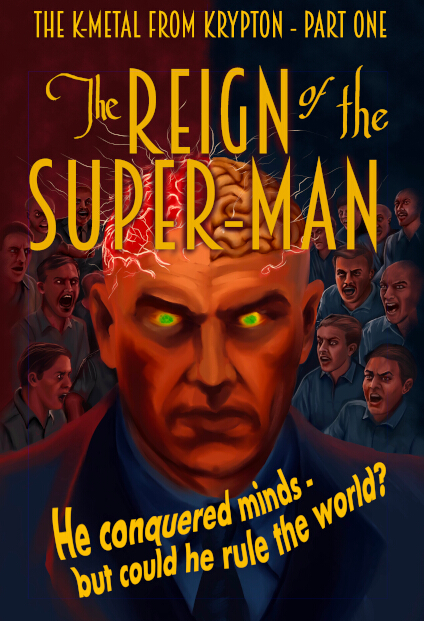
As I shaped this revival, I brought my own choices to the table, adding illustrations to echo the story's most powerful moments. The cover needed to be worthy of pulp science fiction, a striking visual hook to sell the reader on a journey into the unknown. I drew inspiration from the story's wildest beats—like the red-intelligence and tree creature battle on Mars, a fantastical clash that captures the pulp's otherworldly allure. Equally compelling was Dunn asserting his mind-reading powers in the library, his eyes gleaming with newfound dominance, and his exuberant inventorying of those powers, a moment of raw ambition. I included a vignette showing headlines that set Dunn on his greedy course, a subtle nod to the societal forces at play, and another highlighting our McGuffin—the formula for mental power over all—a tantalizing symbol of his rise. The climax, the final battle between Professor Smalley and Dunn, demanded its own space, a tense showdown of intellect and telepathy. And finally, both the desperation of those in the breadline, a haunting echo of the story's opening, then a refrain of the chaos at the International Conciliatory Council, ties it all together. Each illustration was crafted to resonate with these peaks, inviting readers to feel the weight of Dunn's ascent and inevitable fall.
But where does this lead? These threads—personal restoration journeys, format fidelity, illustration intent, and the evolution of narrative art—pull me toward the bigger picture: why resurrect Reign now, in 2025? It's not just nostalgia. This story's core, with its meteor-derived serum granting unstable telepathic powers to a resentful vagrant, echoes forward into Superman's lore, prefiguring Kryptonite's debut in that 1940 narrative I helped restore. So why bring Reign back now? These threads—my journey through early Superman lore, the balance of format and intent, the power of those original images—point to a chance to revisit where it all started. This release, with its new cover echoing Dunn's psychic sway over a divided crowd, invites readers to step into a world where ambition turns to ash, where a single serum can lift a man to godlike heights only to cast him back into the shadows. It beckons you to ponder the fragile line between power and ruin, to trace the roots of a legend still unfolding. How do these early echoes still resonate in our imaginations? What hidden tales might they whisper to those willing to listen? For me, it's about keeping that creative spark alive, one revitalized page at a time, offering a glimpse into the origins that shaped a hero—and perhaps hint at stories yet to come.
Angel Criado